
Best Roofing Solutions for Warehouses and Industrial Buildings in The Bahamas: What Every Facility Manager Should Know

Imagine arriving at your warehouse after a night of heavy rain. The roof is leaking, water is collecting near stored inventory, and part of your operation has to stop while your maintenance team investigates.
What started as a roofing issue has suddenly become a business problem.
For warehouse owners, facility managers, and industrial property operators in The Bahamas, a roof does much more than keep the rain out. It protects valuable equipment, inventory, employees, and the daily operations that keep a business running.
Choosing the right roofing system is therefore not just another construction decision. It's a long-term investment in your building's safety, performance, and reliability.
But with several roofing materials and systems available, which one makes the most sense for an industrial property?
Let's look at the best roofing solutions for warehouses and industrial buildings, what makes each system different, and what facility managers should consider before investing in a new roof.
Why Industrial Buildings in The Bahamas Need the Right Roofing System
The Bahamas presents some unique challenges for commercial and industrial roofing.
Intense sunlight, high temperatures, heavy rainfall, humidity, salt-laden coastal air, and tropical storms can all affect how a roof performs over time.
A roofing system that works well in a cooler climate may not deliver the same results in a tropical environment.
For warehouses and industrial facilities, the consequences can be particularly expensive.
Consider what happens when a roof develops a leak:
Stored products and raw materials may become damaged.
Electrical systems and machinery may be exposed to moisture.
Employees may face safety risks from wet floors.
Business operations may experience unexpected downtime.
Repeated repairs can put additional pressure on maintenance budgets.
This is why choosing roofing solutions should involve more than comparing material prices. The building's structure, roof design, drainage requirements, exposure to weather, and intended use all need to be considered.
The goal is to install a system that protects the property while supporting its long-term operating needs.
5 Roofing Solutions to Consider for Warehouses and Industrial Buildings
Not every industrial building needs the same type of roof. A large distribution warehouse with a low-slope roof has different requirements from a manufacturing facility with a pitched metal roof.
Here are five roofing systems worth considering.
1. TPO Membrane Roofing: A Practical Choice for Commercial Buildings
Thermoplastic Polyolefin, commonly known as TPO, is a single-ply roofing membrane widely used on commercial and low-slope roofing applications.
It's particularly attractive for buildings with large roof areas because it provides a continuous waterproofing layer without relying on overlapping individual roof panels.
One of its biggest advantages is its heat-welded seams. During installation, specialized equipment is used to fuse the membrane sheets together, creating strong connections designed to help prevent water infiltration.
TPO also typically comes with a reflective surface that helps reduce the amount of solar heat absorbed by the roof.
Why consider TPO for an industrial building?
Reflective properties can help reduce roof heat gain.
Heat-welded seams create watertight connections.
Lightweight construction adds relatively little weight to the roof structure.
It is suitable for many commercial low-slope roofing applications.
Its performance can be supported by appropriate insulation and roof assembly design.
For warehouses that rely on climate control, reducing heat entering the building can be a valuable advantage.
However, proper installation is essential. Membrane thickness, attachment method, insulation, flashing details, and wind uplift resistance must all match the building's requirements.
For facility managers looking for modern commercial roofing solutions, TPO is certainly worth evaluating.
2. Torch Membrane Roofing: Reliable Waterproofing for Low-Slope Roofs
Torch-applied membrane roofing is another option for commercial and industrial buildings, particularly those with compatible concrete or low-slope roof structures.
This system typically uses modified bitumen sheets. During installation, heat is applied to bond the material to the prepared roof surface, creating a continuous waterproofing layer.
Its durability and waterproofing capabilities make it a practical choice for suitable applications.
Key advantages include:
Strong waterproofing performance.
Durable membrane construction.
Suitable for compatible low-slope roof assemblies.
Can provide dependable protection against water infiltration when correctly installed.
Useful for certain roof replacement and refurbishment projects.
One consideration is that torch-applied installation involves open flames. Proper fire safety procedures, site preparation, and qualified installation crews are essential.
The existing roof material and building conditions must also be assessed before choosing this system.
For industrial property managers, torch membrane roofing can be a suitable solution when the roof structure and project requirements support its use.
3. PVC Membrane Roofing: Designed for Demanding Commercial Applications
Polyvinyl Chloride (PVC) membrane roofing is another single-ply system commonly used in commercial and industrial applications.
Like TPO, PVC membranes use heat-welded seams to create waterproof connections between membrane sheets.
One feature that makes PVC particularly interesting is its chemical resistance. Certain PVC roofing formulations are designed to withstand exposure to oils, greases, and other substances that may be present around specific industrial operations.
Why consider PVC roofing?
Heat-welded seams provide reliable waterproof connections.
Offers resistance to many chemicals and industrial contaminants.
Reflective options can help reduce heat absorption.
Flexible membrane construction accommodates suitable roof designs.
Can be used on various commercial low-slope roof assemblies.
For warehouses, processing facilities, and buildings with specific rooftop exposure concerns, PVC may be worth considering.
However, chemical exposure varies from one facility to another. The membrane manufacturer should confirm compatibility with the substances present at the site.
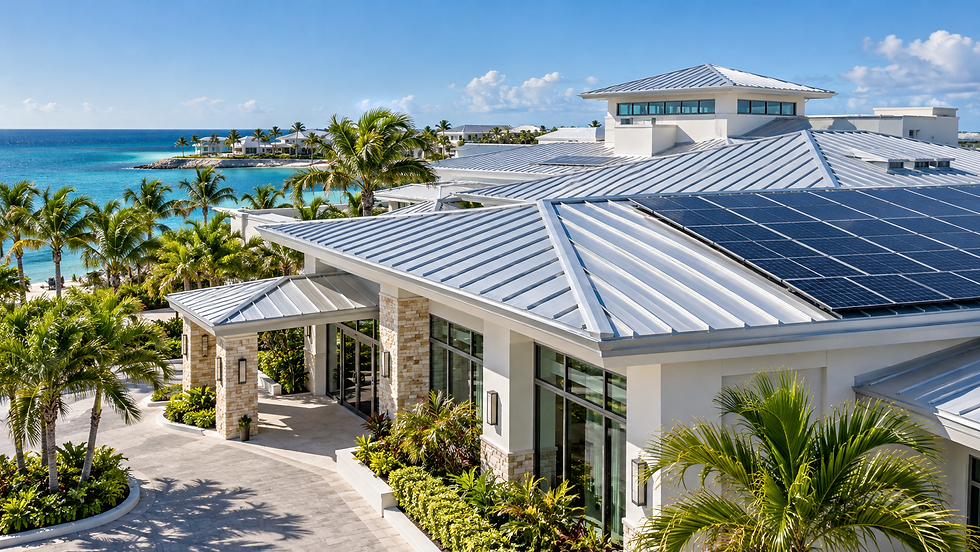
4. Metal Roofing: A Durable Option for Large Industrial Structures
Metal roofing is a familiar choice for warehouses, factories, storage facilities, and other large buildings.
It typically consists of metal panels attached to a supporting roof structure. Depending on the design, panels may be made from coated steel or aluminum.
One of its biggest advantages is its versatility. Metal roofing can accommodate a variety of roof shapes, including pitched and certain low-slope designs.
Benefits of metal roofing include:
Durable construction.
Relatively low maintenance when properly specified.
Resistance to many common weathering conditions.
Available in different profiles and protective finishes.
Suitable for many large-span industrial structures.
In The Bahamas, material selection deserves particular attention. Salt exposure can accelerate corrosion, especially when unsuitable metal finishes or poorly protected fasteners are used.
Proper coatings, compatible fasteners, secure connections, and appropriate installation details are essential.
Metal roofing can be an excellent choice, but its performance in coastal environments depends heavily on material quality and the complete roofing assembly.
5. Modified Bitumen Roofing: Another Option for Low-Slope Buildings
Modified bitumen is an asphalt-based roofing material reinforced with fabrics and modified with polymers to improve its flexibility and performance.
It is commonly installed in multiple layers, depending on the specified system.
For certain warehouses and industrial buildings, it can provide a durable waterproofing solution.
Potential advantages include:
Multi-layer waterproofing options.
Flexibility compared with traditional built-up asphalt systems.
Compatibility with certain low-slope roof designs.
Options for different installation methods.
A proven history in commercial roofing applications.
However, the number of layers, installation method, insulation, and maintenance requirements should be evaluated before selecting this system.
The best choice depends on the condition of the existing roof and the performance requirements of the facility.
What Should Facility Managers Look for When Choosing Roofing Solutions?
Knowing the available roofing materials is only half the decision. The next step is understanding what your particular building needs.
Before approving a roofing project, consider these five factors.
1. Weather and Wind Resistance
In The Bahamas, hurricane preparedness should be part of every commercial roofing discussion.
A roof must be designed to resist the wind pressures expected at its location. This includes more than selecting a strong membrane or metal panel.
The attachment system, roof deck, perimeter details, flashing, fasteners, and overall assembly all contribute to performance.
Ask your roofing contractor how the proposed system addresses wind uplift requirements and applicable Bahamas building regulations.
2. Energy Efficiency and Indoor Temperature
Warehouses can become extremely hot, particularly when large roof areas are exposed to direct sunlight.
Reflective roofing materials, appropriate insulation, and good ventilation can help manage heat entering the building.
For facilities that use air conditioning, improving roof performance may also help reduce cooling demands.
3. Drainage and Water Management
Even a high-quality roofing membrane can experience problems if water has nowhere to go.
Poor drainage can lead to standing water, increased stress on roof components, premature deterioration, and leaks.
Make sure the roofing design includes properly positioned drains, gutters, and downspouts where required.
Drainage should be treated as part of the complete roofing system, not an afterthought.
4. Maintenance Requirements
A roof is not a one-time investment that can be ignored after installation.
Regular inspections help identify damaged seams, loose flashing, blocked drains, corrosion, and other developing problems.
For facility managers responsible for multiple properties, a planned maintenance schedule can make roof management much easier.
5. Total Cost of Ownership
The cheapest roofing option isn't always the most affordable in the long run.
Consider the initial installation cost alongside expected maintenance, energy performance, repair requirements, and the potential cost of business interruptions.
A system that costs more initially may offer better long-term value if it meets the building's needs and is properly maintained.
Why Professional Roof Inspections Matter for Industrial Buildings
One of the biggest mistakes property managers make is waiting until a leak appears before arranging a roof inspection.
By then, water may already have reached insulation, ceilings, electrical components, or stored materials.
A professional inspection can help identify problems before they become expensive repairs.
For warehouses and industrial properties, inspections should pay particular attention to:
Membrane seams and roof penetrations.
Flashing around rooftop equipment.
Roof edges and attachment points.
Drainage outlets and downspouts.
Signs of corrosion or material deterioration.
Areas with standing water or recurring leaks.
Previous repair locations.
It's also worth arranging an inspection after significant storms, particularly if the property has experienced strong winds or heavy rainfall.
Think of it as preventive maintenance for one of your building's most important protective systems.
Protect Your Industrial Property with the Right Roofing Partner
Choosing the right roofing material is only part of the equation. The quality of the assessment, installation, detailing, and ongoing maintenance can make a significant difference in how the system performs.
At Integrity Roofing & Construction, we understand that every property has different requirements.
Based in Nassau, The Bahamas, our team provides commercial roofing services designed to help property owners and managers protect their buildings through quality materials and professional workmanship.
Our commercial roofing solutions include:
TPO Membrane Systems: Reflective, heat-welded roofing membranes for suitable commercial applications.
Torch Membrane Systems: Durable waterproofing solutions for compatible low-slope roofs.
PVC Membrane Systems: Single-ply roofing options for demanding commercial environments.
Metal Roofing Systems: Durable roofing options for suitable commercial and industrial structures.
We also provide roof inspections, repairs, replacement, and other roofing services to help keep your property in good condition.
Our project portfolio includes commercial and institutional work, including TPO membrane installations at La Palmeraie Resort, Marbella Shores, UV Torch Membrane System at the Princess Margaret Hospital and Henrea Plaza and other properties across The Bahamas.
You can explore our completed projects to see examples of our work.
Final Thoughts: Invest in a Roof That Protects Your Business
Your warehouse roof protects more than the building itself. It protects your inve
ntory, equipment, employees, and the operations that keep your business moving.
That's why the right roofing solution should be selected based on durability, weather resistance, energy performance, drainage, and long-term maintenance requirements.
Whether you're considering a new TPO membrane system, torch-applied roofing, PVC membrane, or metal roofing, start with a proper assessment of your building.
Don't wait for a leak or storm damage to force the decision.
A well-planned roofing investment today can help prevent costly disruptions tomorrow.
Need Reliable Roofing Solutions for Your Warehouse or Industrial Building?
Give your commercial property the protection it deserves.
Contact Integrity Roofing & Construction to discuss your roofing requirements, arrange an assessment, and explore the right roofing system for your facility in The Bahamas.
Integrity you can see. Quality you can trust.
Call: (242) 813-8320
Request an estimate: https://www.ircbahamasltd.com/estimate


Comments