
Choosing the Right Roofing System for Bahamas Homes: Shingles, Metal, TPO or Torch Membrane?

The Roof Over Your Head Could Be Your Most Important Building Decision
A roof can look perfect from the ground and still be one storm, leak, or maintenance problem away from becoming a major expense.
For homeowners, that can mean water stains, damaged ceilings, and disrupted daily life. For facility managers, property managers, and asset managers, the stakes can be even higher. A roofing failure can affect tenants, operations, equipment, inventory, budgets, and the long-term value of the property.
That's why choosing a roofing system in The Bahamas isn't simply a matter of picking the material that looks best.
You need to consider the building, roof design, exposure, drainage, maintenance requirements, expected service life, and how the system will perform in a hot, humid, coastal environment.
The Bahamas Building Code includes specific requirements for roof coverings, drainage, and roofing assemblies, including provisions intended to address wind loads.
So, when you're comparing shingles, metal roofing, TPO membrane, and torch-applied membrane, which system makes sense for your property?
Let's break it down.
1. Shingle Roofing: A Practical Choice for Many Homes
Shingles remain a popular option for residential roofing because they're familiar, versatile, and can complement a wide range of architectural styles.
At Integrity Roofing & Construction, shingle installation is part of the company's residential roofing services, with completed projects including shingle installations in The Bahamas.
Why choose shingles?
Shingles can be a good fit when appearance, traditional residential styling, and a practical installation approach are priorities.
They're particularly suitable for many pitched-roof homes where the roof design naturally sheds rainwater.
But there's a catch: the shingle itself isn't the entire roofing system.
Underlayment, flashing, ventilation, fasteners, roof decking, edge details, and installation quality all matter. A premium shingle installed poorly can still lead to problems.
For a facility or maintenance manager, this is a useful reminder: don't compare roofing materials by product name alone. Compare the complete roofing assembly.
Shingles may make sense when:
The building has a pitched residential roof.
You want a traditional appearance.
The existing roof is already designed around shingles.
You want a familiar residential roofing solution.
The roof can be properly detailed for local weather conditions.
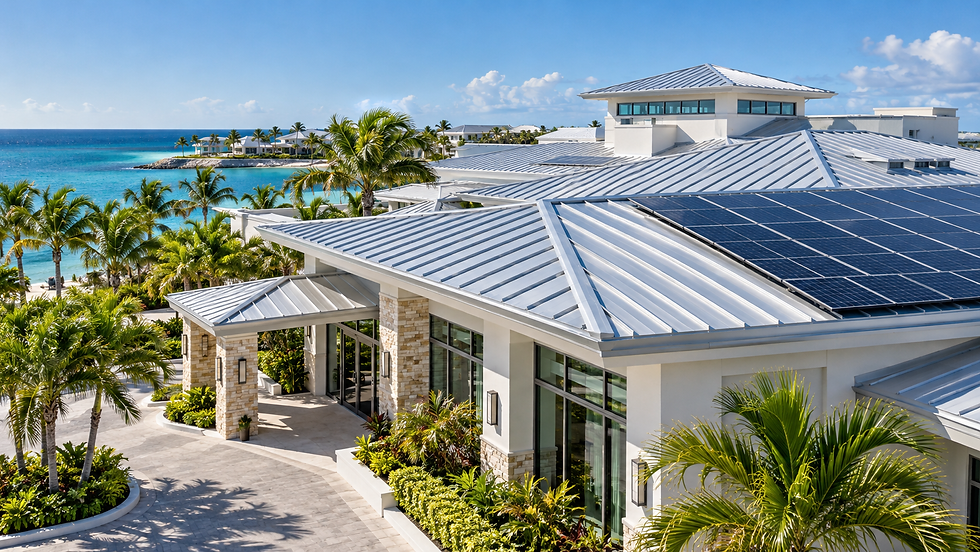
2. Metal Roofing: Durability With a Distinct Look
Metal roofing offers a different approach.
Instead of individual shingles or a membrane covering, metal panels create a durable roof surface that can suit both residential and commercial buildings.
The Bahamas Building Code specifically contains requirements for metal shingle systems, including approved complete systems and related waterproofing components.
For property owners, one of the biggest attractions of metal roofing is its combination of durability, appearance, and relatively straightforward maintenance when properly installed.
But coastal environments require careful attention to materials and detailing.
Salt air, fasteners, seams, penetrations, flashing, and drainage all deserve consideration. The right metal roofing system for a property near the coast isn't necessarily the same specification you'd choose for a building in a dry inland environment.
Metal roofing may make sense when:
You want a long-lasting roofing solution.
The property's architecture suits metal panels.
You're looking for a clean, modern appearance.
The roof requires a durable surface capable of handling the local environment.
Proper corrosion-resistant materials and installation details can be incorporated.
For managers responsible for multiple buildings, it's also worth considering how easy the system will be to inspect and maintain over time.
3. TPO Membrane: A Strong Option for Low-Slope Roofs
Now we get into a roofing system that many facility and building managers should have on their radar: TPO membrane roofing.
TPO, or thermoplastic polyolefin, is a single-ply membrane commonly used on low-slope and commercial roofing applications.
Integrity Roofing & Construction provides TPO membrane systems for both commercial and residential roofing and has completed TPO projects across The Bahamas, including VillaNova Condominiums, La Palmeraie Resort, Marbella Shores, Governor's Harbour, and San Salvador.
So why is TPO worth considering?
Low-slope roofs create different challenges from traditional pitched roofs. Water management, seams, penetrations, flashing, and drainage become critical parts of the system.
A properly designed and installed TPO system provides a continuous membrane across the roof surface, making detailing and installation quality especially important.
For a commercial property, that can make TPO an attractive solution when the building has a suitable low-slope roof.
TPO may make sense when:
The building has a low-slope or commercial-style roof.
You want a continuous membrane roofing system.
Long-term waterproofing performance is a priority.
The roof has multiple penetrations or rooftop equipment that require careful detailing.
You want a roofing system that can be professionally inspected and maintained.
The key phrase here is professionally installed.
With membrane roofing, small details can have big consequences. Seams, edges, penetrations, drains, and transitions need to be handled correctly.
4. Torch Membrane: Built for Certain Roofing Applications
Torch-applied membrane systems are another established option, particularly for suitable low-slope roofing applications.
Instead of mechanically fastening or simply laying the membrane in place, torch-applied systems use heat during installation to bond the membrane to the prepared roof surface.
Integrity Roofing & Construction offers torch membrane systems and has completed UV torch-applied membrane projects, including work at Henrea Plaza and the Princess Margaret Hospital administration building.
Torch membrane can be particularly useful when a robust waterproofing system is required for a compatible roof assembly.
However, installation requires trained professionals and strict attention to safety and detailing because the process involves open-flame equipment.
Torch membrane may make sense when:
The roof is suitable for a torch-applied membrane system.
Waterproofing performance is a major concern.
The existing roof assembly can support the system.
The project requires a membrane solution suited to the building's design.
Experienced installers and appropriate safety procedures are available.
As with TPO, the material is only part of the equation. The condition of the existing roof, substrate preparation, drainage, flashing, penetrations, and installation quality all need to be assessed.
Shingles vs. Metal vs. TPO vs. Torch Membrane
There's no universal roofing material that belongs on every Bahamas home or commercial building.
Instead, think about the decision this way:
Roofing System | Often Suited To | Key Consideration |
Shingles | Pitched residential roofs | Appearance, complete system installation, weather detailing |
Metal Roofing | Residential and commercial roofs | Material selection, corrosion resistance, fasteners and detailing |
TPO Membrane | Low-slope residential/commercial roofs | Seams, drainage, penetrations and professional installation |
Torch Membrane | Suitable low-slope roof assemblies | Waterproofing details, substrate preparation and installation safety |
The best starting point isn't asking, "Which roof is cheapest?"
It's asking:
"Which roofing system is appropriate for this building, this roof design, and this property's long-term needs?"
That shift can save a property owner from making a decision based solely on upfront price.
What Facility and Property Managers Should Consider Before Choosing
If you're responsible for a building in The Bahamas, take a step back before approving a roofing replacement.
1. What type of roof do you have?
A pitched residential roof and a large low-slope commercial roof may require completely different solutions.
2. What's underneath the existing roof?
A new roof doesn't erase problems underneath it. Damaged decking, poor drainage, deteriorated substrates, or structural issues should be identified before installation begins.
3. How does the roof handle water?
The Bahamas Building Code addresses roof drainage and requires roof systems to be designed appropriately for rainwater disposal.
A beautiful new roof with poor drainage is still a problem waiting to happen.
4. How exposed is the building?
Coastal exposure, wind conditions, building height, roof geometry, and surrounding structures can all influence the roofing solution and detailing required.
5. What will maintenance look like five or ten years from now?
A roof isn't a one-day purchase. It's an asset.
Think about inspections, repairs, access, drainage, penetrations, warranties, and expected maintenance before making the final decision.
The Right Roofing System Starts With the Right Assessment
Imagine two buildings.
They sit only a few miles apart, but one has a steep residential roof while the other has a broad, low-slope commercial roof covered with mechanical equipment and penetrations.
Choosing the same roofing system simply because it worked on the first building doesn't necessarily make sense.
That's why Integrity Roofing & Construction approaches roofing as a property-specific decision.
The company provides residential and commercial roofing services, including shingles, metal roofing, TPO membrane, torch membrane, PVC membrane, roof inspections, repairs, maintenance, and replacement.
The goal isn't simply to put a new material on top of a building.
It's to understand the building first.
Final Thoughts: Don't Choose a Roof From the Ground
From the ground, most roofs look simple.
Up close, they're anything but.
The right roofing system has to work with the building's design, drainage, structure, environment, maintenance requirements, and long-term goals. Shingles may be the right fit for one home. Metal may suit another. A TPO or torch membrane system may make more sense for a low-slope roof.
The smartest decision starts with an inspection and a conversation—not a guess based on what's cheapest or most familiar.
If you're planning a roof replacement, dealing with recurring leaks, managing a commercial property, or simply want to know whether your current roofing system is still doing its job, Integrity Roofing & Construction can help you evaluate your options.
From roof inspections and repairs to complete roof replacements, TPO membrane systems, torch membrane systems, shingles, and metal roofing, the team provides tailored roofing solutions for properties across The Bahamas.
Integrity Roofing & Construction — Integrity you can see, quality you can trust.


Comments